
DeepSeek V4.1 Flash Review (2026): Is This 1M-Context AI Model Worth Using?
DeepSeek V4.1 Flash review covering its 552B MoE architecture, 1M-token context, coding benchmarks, API pricing, vision capabilities and limitations.

Artificial intelligence models are becoming more capable, but running advanced AI systems efficiently remains a major challenge. Large models can require substantial computing resources, while smaller models sometimes struggle with complex reasoning, coding and multi-step tasks.
DeepSeek V4.1 Flash takes a different approach.
It combines a large Mixture-of-Experts (MoE) architecture with an asymmetric design that activates different amounts of model capacity during input processing and output generation. It also supports a context window of up to one million tokens and native visual understanding.
But impressive specifications do not automatically make an AI model the right choice.
In this DeepSeek V4.1 Flash review, we examine its architecture, context window, published benchmark results, API access, pricing considerations, deployment requirements, strengths and limitations. We also explain what changed from the earlier DeepSeek V4 Flash generation.
Our short verdict: DeepSeek V4.1 Flash is a compelling model for developers, AI agents, long-context workflows and multimodal applications. Its architecture is technically interesting, but users should evaluate real-world performance, API costs and deployment requirements before choosing it for production.
1. What Is DeepSeek V4.1 Flash?
DeepSeek V4.1 Flash is a multimodal large language model developed by DeepSeek. It belongs to the company's V4 model family and uses a Mixture-of-Experts architecture designed to balance model capacity and computational efficiency.
Unlike a conventional dense model, an MoE model does not activate every expert for every token. Instead, a routing mechanism selects a smaller group of experts to process each token.
The V4.1 Flash architecture also introduces a Causal Encoder–Decoder design. This allows it to use different active-parameter budgets for input processing and output generation.
According to DeepSeek's September 2026 release announcement, the model has:
552 billion backbone parameters.
8 billion active parameters for input processing.
16 billion active parameters for output generation.
A context window of up to 1,048,576 tokens.
Native visual understanding.
An updated architecture designed for faster inference and higher throughput.
These figures describe the model architecture, not the amount of memory required to run the complete model locally.
The distinction matters because a model with 552B backbone parameters is still a very large system, even if only a fraction of its parameters are active for an individual token.
2. DeepSeek V4.1 Flash Specifications
Here is a summary of the major published specifications.
Specification | Details |
|---|---|
Model | DeepSeek V4.1 Flash |
Developer | DeepSeek |
Model family | V4 |
Architecture | Mixture of Experts |
Backbone parameters | 552B |
Active input parameters | 8B |
Active output parameters | 16B |
Context window | Up to 1,048,576 tokens |
Vision support | Native visual understanding |
Architecture design | Causal Encoder–Decoder |
Latest identified checkpoint | V4.1-Flash-1017 |
API model name |
|
Model category | Multimodal AI |
Primary applications | Chat, coding, agents, reasoning and document workflows |
Important: The 552B backbone figure refers to the model's main parameter count. DeepSeek's technical report and inference documentation also describe additional Engram memory components. Backbone parameters, active parameters and memory requirements should not be treated as interchangeable measurements.
3. Understanding the 552B Mixture-of-Experts Architecture
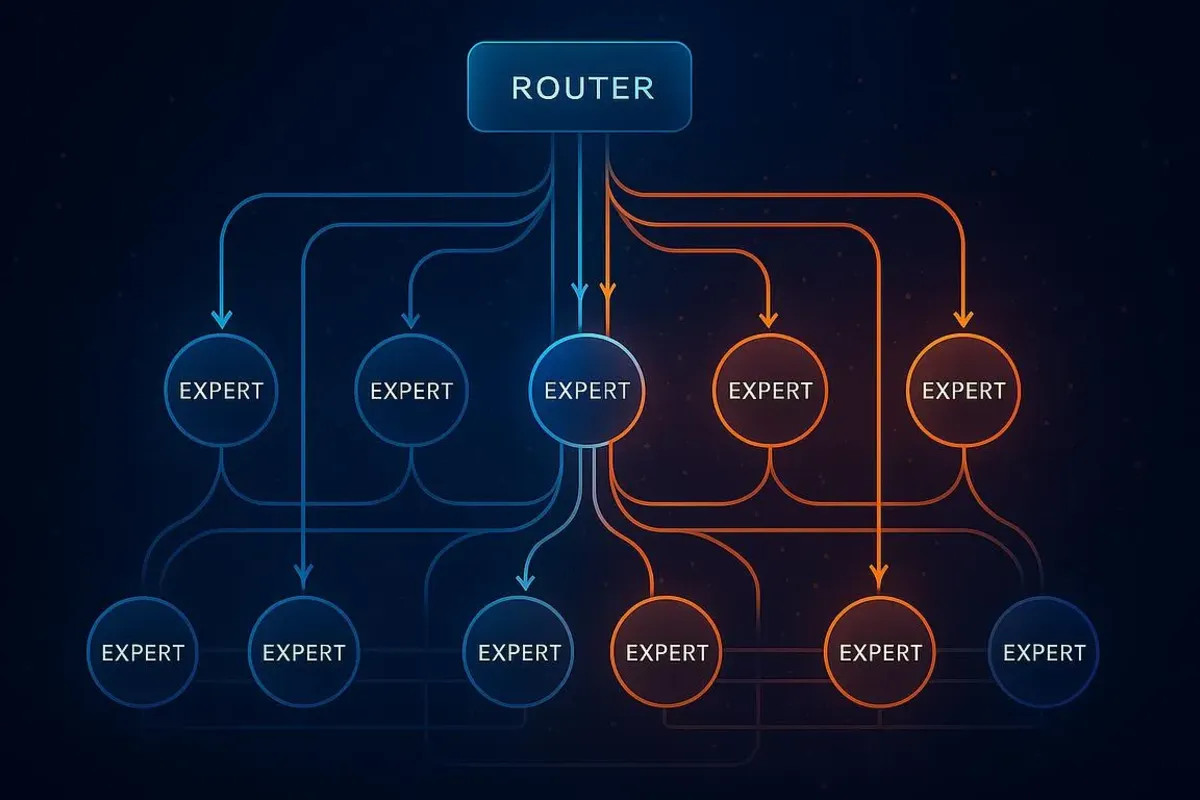
One of the most interesting aspects of DeepSeek V4.1 Flash is its architecture.
A traditional dense language model generally uses its full parameter network for each token. A Mixture-of-Experts model takes another approach.
It contains multiple specialized expert networks. A routing mechanism determines which experts should process a particular token.
This allows the model to maintain a large overall capacity without activating every expert during every computation.
How does the MoE system work?
At a simplified level, the process looks like this:
The model receives text or supported visual input.
Its routing mechanism evaluates the token.
Relevant expert networks are selected.
The selected experts process the information.
Their results contribute to the model's next prediction.
This design can improve computational efficiency compared with activating the entire network for every token.
However, MoE does not eliminate hardware requirements. The model still needs access to its expert weights, and distributed inference can require substantial memory, storage bandwidth and networking capacity.
Why the asymmetric architecture matters
V4.1 Flash uses a Causal Encoder–Decoder architecture.
Its published design activates approximately:
8B parameters per input token during prefill.
16B parameters per generated output token during decoding.
This is different from simply describing the model as a 16B model. The 552B backbone remains important when considering the complete model and its deployment requirements.
Our assessment: The architecture is one of the model's strongest technical features. It is designed to balance a large model capacity with a more efficient active computation path. Actual speed and cost, however, depend on the serving infrastructure and workload.
4. The 1 Million Token Context Window
A major feature of DeepSeek V4.1 Flash is its one-million-token context window.
A context window determines how much information a model can consider within a single interaction or processing request.
A larger context window can be useful when working with:
Long research documents.
Large code repositories.
Technical manuals.
Multiple related documents.
Long conversations.
Complex agent workflows.
For example, a developer could provide several related source files and ask the model to identify dependencies, explain a function or locate a potential issue.
A researcher could use a long-context workflow to examine multiple reports and identify recurring themes.
However, a one-million-token context window does not guarantee perfect recall or accurate reasoning across every token.
Long-context performance can vary depending on information placement, task complexity, prompt design, retrieval strategy and serving limits.
It is also important to distinguish the advertised context window from the maximum output length. They are separate limits.
Our assessment: The one-million-token context is valuable for document-heavy and code-heavy applications, but users should test retrieval accuracy and response quality with their own material rather than relying on the context number alone.
5. Published Benchmarks and Performance
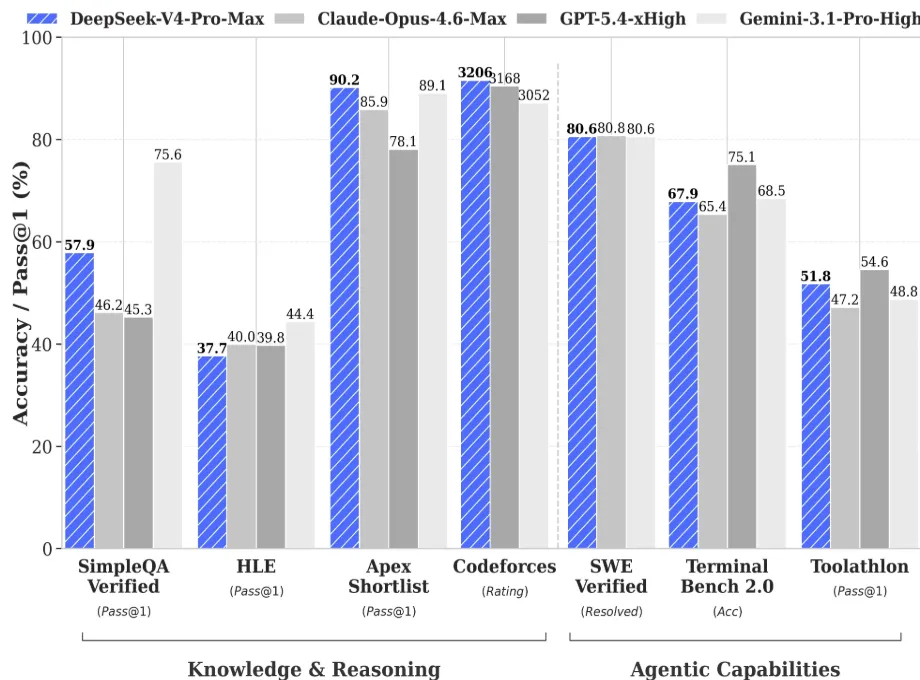
Benchmarks provide a useful way to compare AI models, but they need careful interpretation.
DeepSeek publishes benchmark results for V4.1 Flash, including tests involving reasoning, mathematics, coding, software engineering, agents and visual understanding.
The September 2026 release documentation reports the following results:
Benchmark | Published result |
|---|---|
GPQA Diamond | 90.9 |
HLE | 36.8 |
HLE with tools | 63.9 |
Codeforces Rating | 3471 |
MathArena Apex | 65.6 |
Terminal-Bench 2.1 | 90.6 |
Terminal-Bench 3.0 | 30.0 |
Terminal-Bench 4.0 | 31.2 |
DeepSWE v1.1 | 74.2 |
ProgramBench | 20.3 |
NL2Repo-Bench | 65.4 |
CyberGym | 88.1 |
SEC-Bench Pro | 62.8 |
ExploitGym | 15.3 |
Source: DeepSeek's V4.1 Flash release documentation. Benchmark scores are reproduced as published by the developer; they are not independent SamReview laboratory measurements.
What do these results tell us?
Reasoning: GPQA Diamond and HLE provide insight into difficult knowledge and reasoning tasks. A high score is encouraging, but benchmark performance does not guarantee that every answer will be correct.
Coding: Codeforces, ProgramBench and software-engineering benchmarks help evaluate different aspects of programming ability. They do not all measure the same skill.
Agent performance: Terminal-Bench and DeepSWE focus on tasks involving tool use and multi-step software workflows. These are particularly relevant to AI coding agents.
Visual understanding: Visual benchmarks help evaluate image-related tasks, although results depend on the exact test setup and tools used.
A note about the 1017 checkpoint
DeepSeek announced an updated V4.1 Flash checkpoint on October 17, 2026, named V4.1-Flash-1017.
The API documentation identifies this as the newer model update. Some published benchmark comparisons show improvements over the September launch checkpoint, but users should check which checkpoint and evaluation setup a particular result represents.
Do not combine results from different model versions into one benchmark table without identifying their versions.
Our assessment: The published results make V4.1 Flash worth evaluating for coding, reasoning and agent workflows. Independent testing under consistent conditions is still necessary before making a definitive performance ranking.
6. Native Vision: More Than a Text-Only Model
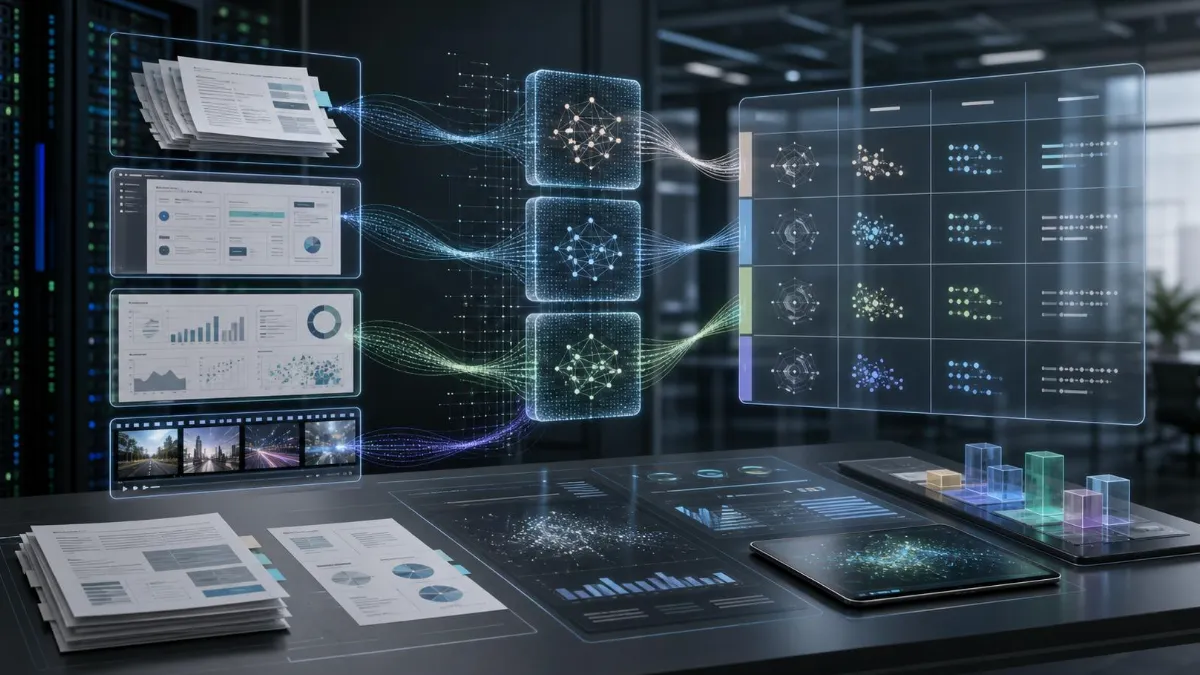
V4.1 Flash introduces native visual understanding.
This expands its potential applications beyond conventional text-based chat.
Depending on the supported API interface and task, visual workflows may include:
Understanding images.
Extracting information from visual material.
Analyzing screenshots.
Interpreting charts and diagrams.
Combining image and text information.
For developers, this opens possibilities for applications that need both language and visual input.
For example, an application could send a screenshot alongside a text instruction and ask the model to explain what is visible.
However, image support does not mean every image-processing task will be equally reliable. Small text, complex diagrams, low-resolution images and ambiguous visual details can still create errors.
Users should also verify which visual input formats and limits are supported by their selected API or deployment environment.
7. API Access and Pricing
For many users, accessing DeepSeek through its hosted API is more practical than deploying the complete model locally.
The current API model name is:
deepseek-flash
The API documentation states that the previous V4 Flash and V4 Flash Vision Experimental model names have been retired. Older identifiers may temporarily route to V4.1 Flash for compatibility.
That means developers should use the current model identifier in new integrations rather than building a new application around a retired model name.
What about API pricing?
DeepSeek has introduced separate peak and off-peak pricing for V4.1 Flash.
The actual cost depends on factors such as:
Input tokens.
Output tokens.
Cached input tokens.
Peak or off-peak usage.
The current official pricing schedule.
Because API prices can change, we recommend checking the official pricing page before estimating production costs.
Official resources:
Is the API suitable for developers?
The hosted API can be a practical starting point for applications that need model access without managing a large inference cluster.
Potential use cases include:
AI chat applications.
Coding assistants.
Research tools.
Document analysis.
Agent-based automation.
Multimodal applications.
Before using the API in production, developers should test latency, reliability, rate limits, token usage, output quality and data-handling requirements.
8. Can You Run DeepSeek V4.1 Flash Locally?
This is one of the most important questions for users interested in open-weight AI models.
The short answer is that local deployment is a specialized infrastructure task, not a simple installation.
A 552B-parameter model has a substantial memory footprint. Its actual requirements depend on the checkpoint format, quantization, inference engine, context length, KV cache, batch size and hardware configuration.
A smaller quantized file does not automatically mean the model can run smoothly on an ordinary desktop computer.
Why 128GB RAM is not a universal requirement or guarantee
You may encounter claims suggesting that a quantized model can fit within a particular memory configuration.
Those claims need context.
Even if a particular weight format can be stored across available system memory and devices, successful inference also depends on:
Whether the inference engine supports the architecture.
How model weights are distributed.
Available GPU or accelerator memory.
Memory bandwidth.
CPU and GPU offloading.
KV cache requirements.
Context length and concurrent requests.
Therefore, we would not describe 128GB RAM as a guaranteed configuration for running the complete V4.1 Flash model.
A system may load some quantized configurations but still perform poorly, fail at longer context lengths or require additional accelerators.
What should local users check?
Before downloading a model, verify:
The exact model checkpoint.
The supported quantization format.
The inference engine's architecture support.
The documented hardware requirements.
The maximum practical context length.
Whether multimodal inference is supported.
The official model repository and the inference framework's deployment guide should be treated as the primary references.
Useful resources:
Our assessment: Hosted API access is the more practical starting point for most individual developers. Local deployment is better suited to teams with the required hardware and inference expertise.
9. DeepSeek V4 Flash vs V4.1 Flash: What Changed?
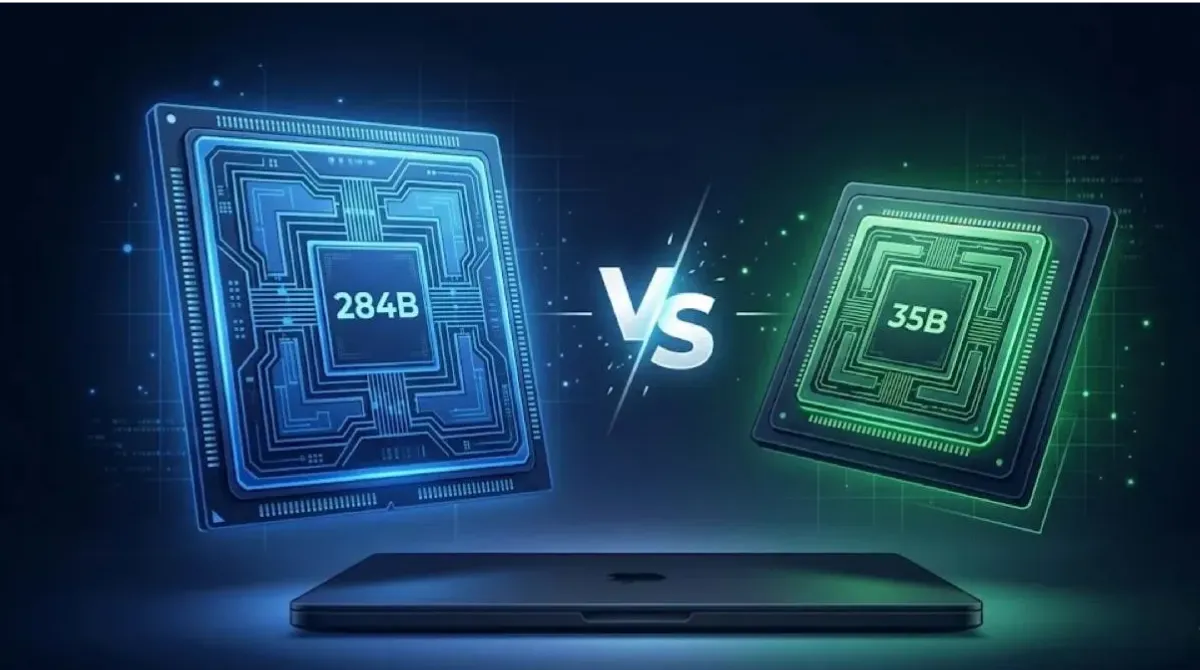
The names are similar, but the versions should not be treated as interchangeable models.
DeepSeek has retired the earlier V4 Flash generation from its API and introduced V4.1 Flash with a different architecture.
Feature | Earlier V4 Flash | V4.1 Flash |
|---|---|---|
Model generation | Original V4 Flash | Updated V4.1 Flash |
Architecture | Earlier V4 design | Causal Encoder–Decoder MoE |
Backbone parameters | 284B | 552B |
Active parameters | 13B | 8B input / 16B output |
Context window | Up to 1M | Up to 1M |
Native visual understanding | Not the same native vision release | Yes |
Current API identifier | Retired legacy identifier |
|
Current status | Retired | Current API generation |
The table describes the earlier model and the newer V4.1 generation. It should not be interpreted as an independent head-to-head performance test.
Which version should developers use?
For new API projects, use the current deepseek-flash model identifier and consult the latest documentation.
If you are maintaining an older integration, check whether it still uses a legacy model identifier and update it where necessary.
The key lesson is simple: a review of the original V4 Flash model is not the same as a review of V4.1 Flash.
10. DeepSeek V4.1 Flash: Main Advantages
1. Large model capacity
The 552B backbone gives the model a substantial overall capacity while MoE routing limits the active computation for each token.
2. Asymmetric computation
The 8B input and 16B output active-parameter design is an important architectural feature.
3. One-million-token context
A large context window is useful for long documents, codebases and complex information workflows.
4. Native visual understanding
The model can support applications that combine image and text input.
5. Developer-focused applications
Its coding, agent and tool-oriented benchmark coverage makes it relevant to software development workflows.
6. Hosted API availability
Developers can experiment through the API without operating the full model infrastructure themselves.
11. DeepSeek V4.1 Flash: Limitations
No AI model is perfect, and V4.1 Flash has important limitations.
1. Large underlying model
Despite its active-parameter efficiency, the full model has a substantial backbone. Local deployment can be expensive and technically demanding.
2. Benchmarks are not real-world guarantees
Published benchmark scores are useful reference points, not proof that the model will outperform alternatives on every task.
3. API costs can change
Peak and off-peak rates, caching and token consumption can affect the total cost of an application.
4. Long context does not guarantee perfect recall
A one-million-token window does not eliminate hallucinations, missed details or reasoning errors.
5. Deployment support may vary
Inference engines and quantization formats may not support every model feature equally.
6. Human verification remains important
For production code, financial decisions, security analysis and other important tasks, model outputs should be checked.
12. Who Should Use DeepSeek V4.1 Flash?
V4.1 Flash may be worth evaluating for:
Software developers: Those building coding assistants, code-analysis systems and development tools.
AI application builders: Developers who need chat, tool calling, document processing or multimodal features.
Researchers: Users working with long documents and complex information.
AI agent developers: Teams experimenting with multi-step workflows and tool-using agents.
Technical teams: Organizations evaluating a large MoE model through a hosted API or supported inference infrastructure.
13. Who Should Avoid It?
V4.1 Flash may not be the right choice for everyone.
It may be unsuitable for:
Users who only need simple offline text generation.
People expecting a 552B model to run easily on a typical laptop.
Applications requiring guaranteed factual accuracy without verification.
Teams that have not evaluated API cost and latency.
Developers whose required deployment framework does not support the model's architecture.
Choosing an AI model should depend on the task, budget, infrastructure and reliability requirements—not just the parameter count.
14. DeepSeek V4.1 Flash vs Other AI Models
There is no single best AI model for every application.
Different models can perform differently depending on the task, context length, reasoning requirements, coding environment, vision support and price.
When comparing V4.1 Flash with other AI systems, evaluate:
Comparison area | What to examine |
|---|---|
Reasoning | Accuracy on your actual tasks |
Coding | Debugging, repository understanding and code quality |
Context | Practical performance with long inputs |
Vision | Accuracy on your image-based tasks |
Speed | Time to first token and total response time |
Cost | Total input and output cost |
Reliability | Consistency across repeated tests |
Deployment | API, hardware and software compatibility |
We do not assign a definitive winner without a consistent, independently reproducible comparison using the same prompts, settings and evaluation conditions.
15. How We Evaluated This Model
SamReview editorial methodology
This article is a research-based technical review. It is not a claim that SamReview independently trained, benchmarked or physically tested the complete 552B model.
Our evaluation approach considers:
Official DeepSeek announcements and API documentation.
Published model specifications.
Available technical reports.
Published benchmark results and their stated testing conditions.
Model version and API naming changes.
Deployment documentation from inference-framework developers.
Practical implications for developers and everyday users.
We distinguish developer-reported benchmark results from independent measurements.
We also avoid presenting estimated hardware requirements as guaranteed deployment specifications.
For a production decision, readers should conduct their own tests using representative workloads.
16. Final Verdict: Is DeepSeek V4.1 Flash Worth Trying?
DeepSeek V4.1 Flash is an interesting development in large-scale AI architecture.
Its 552B backbone, asymmetric active-parameter design, one-million-token context window and native visual understanding make it relevant to developers building more advanced AI applications.
Its biggest strength is not simply its parameter count. It is the combination of a large MoE architecture with a design intended to improve inference efficiency and support complex workloads.
However, the model is not automatically the best choice for every user.
Local deployment requires serious consideration of hardware and inference support. API users need to monitor current pricing and test their own workloads. Benchmark results should be treated as useful evidence rather than universal performance guarantees.
Our editorial conclusion: DeepSeek V4.1 Flash deserves attention from developers, researchers and AI application builders. For most individual users, starting with the hosted API is more practical than attempting to run the complete model locally.
SamReview Rating
Review area | Editorial assessment |
|---|---|
Architecture | Excellent potential |
Context capability | Excellent |
Coding and agent potential | Promising |
Multimodal capability | Strong feature set |
Local accessibility | Hardware-intensive |
Developer usefulness | High potential |
Overall editorial verdict | Worth evaluating |
Overall Rating: 9.0/10 — Research-Based Editorial Assessment
This is SamReview's editorial assessment, not an independently measured benchmark score. The rating reflects the model's published architecture and capabilities alongside its hardware, evaluation and deployment limitations.
Frequently Asked Questions
1. What is DeepSeek V4.1 Flash?
DeepSeek V4.1 Flash is a multimodal Mixture-of-Experts AI model with a 552B backbone, an asymmetric 8B/16B active-parameter design and support for up to one million tokens of context.
2. Is DeepSeek V4.1 Flash free?
The hosted API is usage-based. The final cost depends on token consumption, caching and the current pricing schedule. Check DeepSeek's official pricing documentation for current rates.
3. What is the context length of DeepSeek V4.1 Flash?
It supports a context window of up to 1,048,576 tokens, subject to the selected interface and applicable limits.
4. Can DeepSeek V4.1 Flash understand images?
Yes. V4.1 Flash includes native visual understanding, allowing supported applications to process image and text input.
5. Can I run DeepSeek V4.1 Flash on a normal PC?
The complete model is very large. A typical desktop PC should not be assumed capable of running it smoothly. Hardware, quantization, inference-engine support and memory requirements must be checked first.
6. Is 128GB RAM enough to run DeepSeek V4.1 Flash?
There is no universal guarantee. The answer depends on the exact checkpoint, quantization, available accelerators, offloading configuration and context length.
7. What is the current DeepSeek Flash API model name?
The current API model identifier is deepseek-flash. Older V4 Flash identifiers have been retired and may temporarily route to V4.1 Flash for compatibility.
8. Is DeepSeek V4.1 Flash good for coding?
Its published coding and software-engineering benchmark results make it worth evaluating for coding tasks. Developers should test it against their own codebases and workflows.
9. What is the difference between DeepSeek V4 Flash and V4.1 Flash?
V4.1 Flash introduces a different 552B MoE architecture, an asymmetric 8B input and 16B output active-parameter design, and native visual understanding. The earlier V4 Flash generation has been retired from the API.
10. Is DeepSeek V4.1 Flash suitable for AI agents?
It is designed for applications including tool use and agentic workflows. Actual performance depends on the tools, prompts, orchestration framework and task being evaluated.
Official Sources and Further Reading
The following sources were used to prepare this research-based review.
Editorial note: Model specifications, API availability, prices and deployment support can change. This article reflects information reviewed on November 15, 2026. Readers should consult the official documentation for the latest technical and pricing details.
Disclosure: This article contains no affiliate links or paid product-placement recommendations. SamReview's purpose here is to provide independent, informative technology coverage for readers.
✍️ More from Nil Ratan Karmakar
How to Use ChatGPT for Free (2026): Complete Beginner's Guide
ChatGPT vs Claude vs Gemini: Which AI Is Best in 2026?
Claude AI Review 2026: Features, Pricing, Claude Code & Real-World Limitations
ChatGPT Review 2026: Features, Pricing, GPT-6, Pros & Cons – Is It Worth Using?
Best VPN Services in 2026: NordVPN vs ExpressVPN vs Surfshark vs Proton VPN vs Mullvad
Reviews & Comments (0)
No comments yet. Be the first to share your thoughts!
Nil Ratan Karmakar
Nil Ratan Karmakar is a Software Specialist and Senior Reviewer at SamReview. With over 8 years of dedicated experience in the software industry, he specializes in testing and analyzing SaaS platforms, productivity tools, AI software, and mobile applications. Before joining SamReview, Nil worked as a software analyst, where he developed a deep understanding of user experience (UX), software architecture, and performance optimization. He is passionate about helping users find the right software solutions to boost their productivity and workflow. Outside of reviewing software, Nil enjoys exploring new tech trends and contributing to open-source projects.
Read Next
View All →
Best Laptops for Programming in 2026: Black Friday Deals, Prices & Reviews
Find the best laptops for programming in 2026 with Black Friday prices, regular price comparisons, savings, specifications, pros and cons.

Best Budget Laptops Under $500 in 2026
Find the best budget laptops under $500 in 2026. Compare Acer, ASUS, Lenovo and Chromebook options, with pros, cons and buying advice.
Best Laptops for College Students in 2026: 7 Top Picks
Find the best laptops for college students in 2026. Compare MacBooks, Windows laptops and Chromebooks for budget, battery life, engineering, and everyday study.

Best Black Friday TV Deals 2026: 7 TVs Worth Buying, Reviews
Find the best Black Friday TV deals 2026. Compare LG, Samsung and Sony OLED, QLED and Mini LED TVs, prices, pros, cons and buying options.