
Apple's $2,899 MacBook Pro Has a 24GB Problem: NVIDIA vs AMD
Apple's $2,899 MacBook Pro starts with 24GB unified memory. Compare NVIDIA RTX Spark and AMD Strix Halo to find the best hardware for local AI, developers and power users.

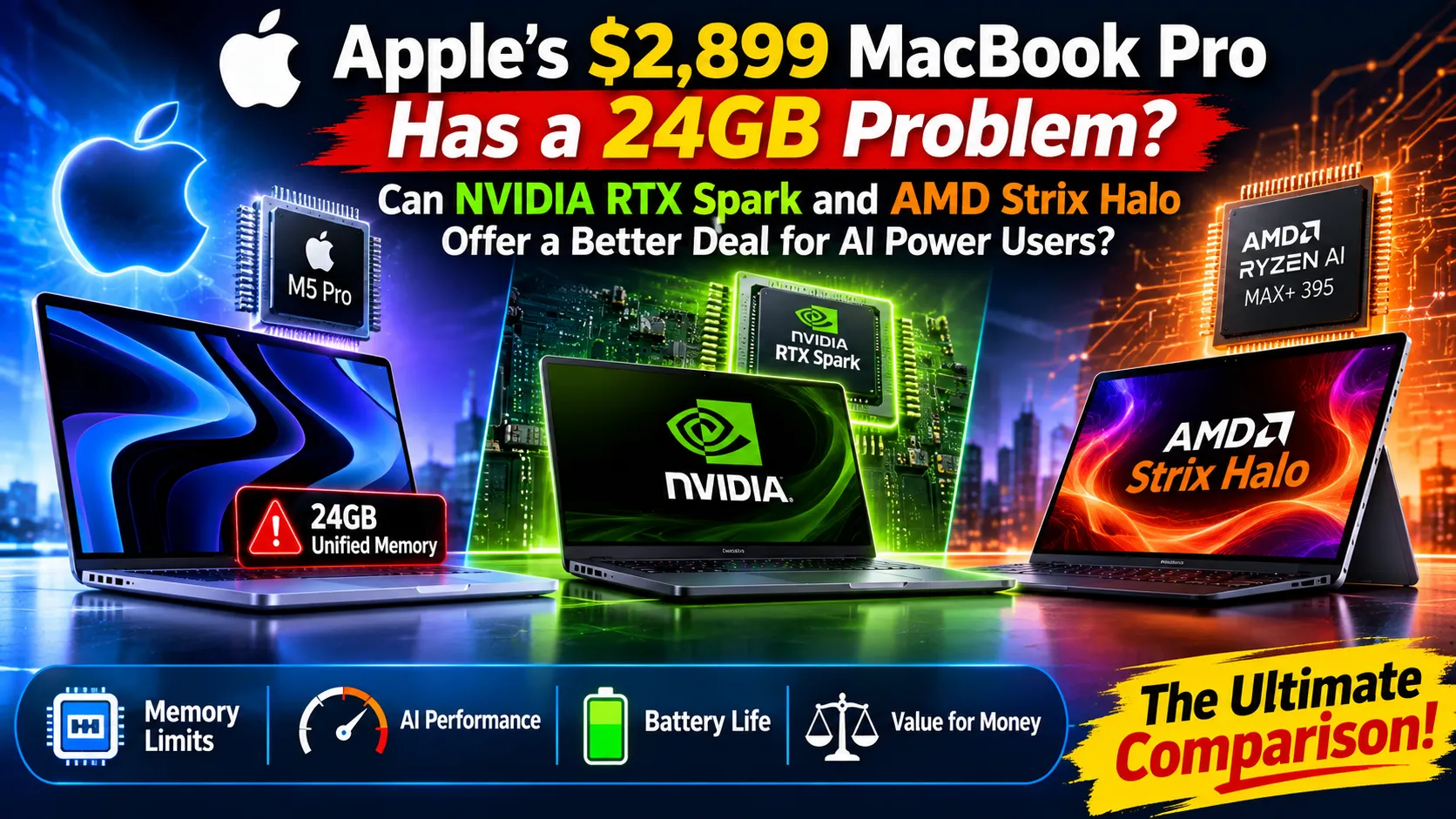
Apple's $2,899 MacBook Pro Has a 24GB Problem — Can NVIDIA RTX Spark and AMD Strix Halo Offer a Better Deal for AI Power Users?
Apple's premium MacBook Pro delivers an exceptional display, powerful performance and excellent battery life. But for people running large AI models locally, its entry-level 24GB memory configuration raises an important question: are Windows-based AI machines becoming a smarter investment?
Apple has built its reputation on making powerful computers feel effortless. The latest MacBook Pro continues that tradition, combining Apple's M5 Pro processor, a premium display and the familiar macOS experience in a refined professional laptop.
But the definition of a professional computer is changing.
Developers, researchers, creators and AI enthusiasts increasingly want to run large language models, AI agents, image-generation tools and development environments directly on their own hardware. For these workloads, processor speed is only one part of the equation. Memory capacity, memory bandwidth, GPU architecture and software compatibility can matter just as much.
That is where Apple's entry-level configuration faces a challenge.
At a starting price of $2,899, the 14-inch MacBook Pro with M5 Pro, 24GB of unified memory and 1TB of storage is an expensive machine to buy if your primary goal is local AI development.
Meanwhile, NVIDIA's RTX Spark platform and AMD's Strix Halo-powered systems are targeting users who want more memory and greater flexibility for demanding workloads.
The question is no longer simply which computer is faster. It is which platform gives power users the most useful computing resources for their money.
1. The MacBook Pro's 24GB Memory Question
Apple's unified memory architecture is one of the company's biggest technical advantages. Instead of maintaining completely separate pools of system RAM and graphics memory, Apple silicon allows the CPU and GPU to access a shared memory pool.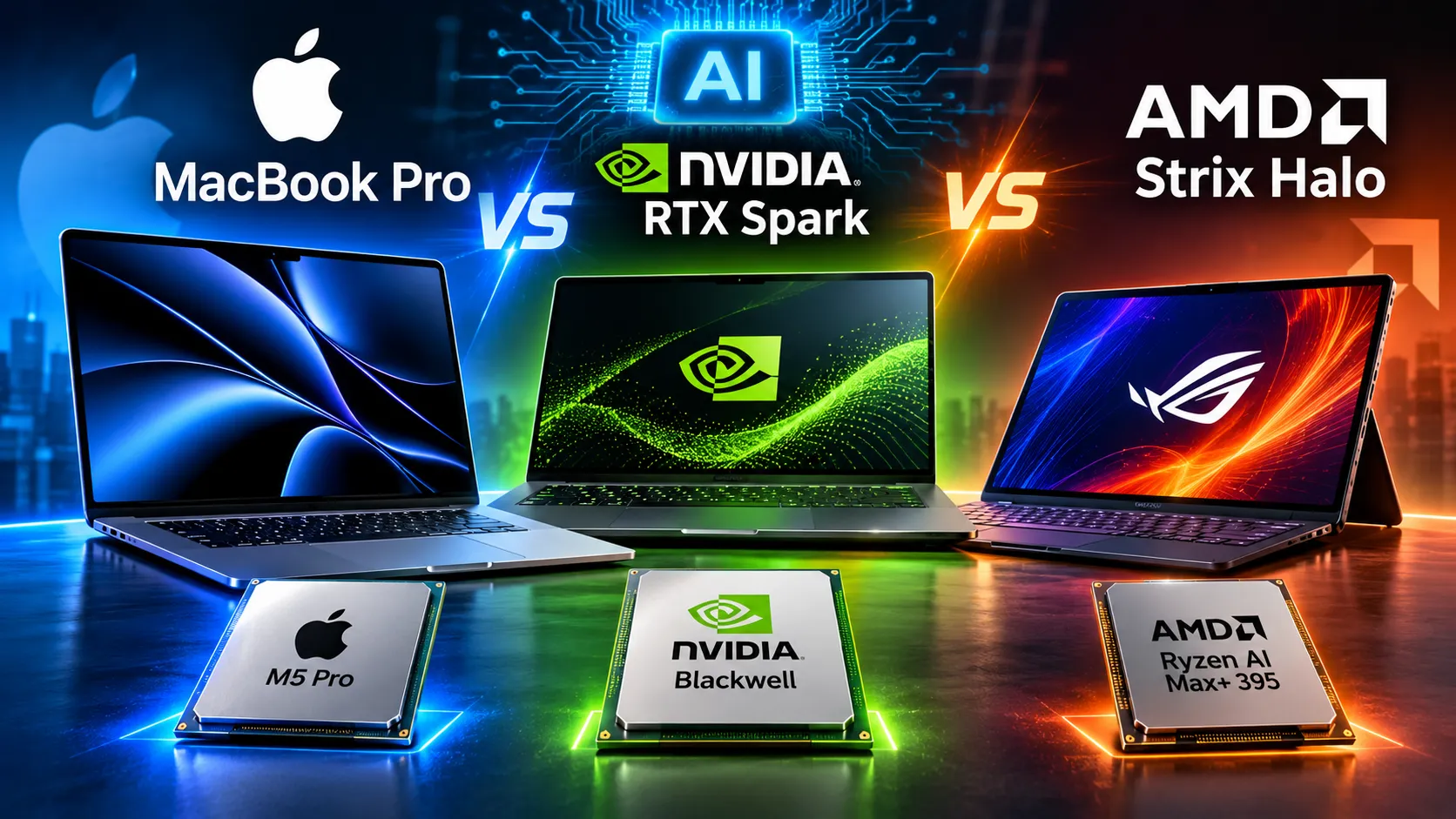 This can be highly efficient.
However, unified memory capacity still matters. The operating system, applications, graphics workloads and AI models all compete for the same available memory.
The entry-level M5 Pro configuration starts with 24GB. That is sufficient for professional productivity, software development, photo editing and many video workflows. But local AI workloads can quickly become more demanding.
A model that fits comfortably into memory can be much easier to run than one that requires memory offloading, aggressive quantization or a smaller model configuration.
Apple does offer higher-memory configurations, including options reaching 128GB with the M5 Max. But upgrading to those configurations changes the price equation considerably.
The real issue is not that macOS cannot run local AI. It is that the entry-level MacBook Pro may not offer enough memory headroom for the most ambitious local AI workflows.
2. NVIDIA RTX Spark: A Different Approach to Personal AI
NVIDIA is approaching the next generation of personal computing from a different direction.
Its RTX Spark platform is designed around NVIDIA's Blackwell architecture and CUDA software ecosystem. The high-end N1X configuration is listed with up to 128GB of unified LPDDR5X memory, a 20-core Grace CPU and up to 1 petaflop of FP4 AI performance.
That combination is particularly interesting for developers working with local AI models.
The biggest advantage is not simply the amount of memory. It is the combination of memory capacity and access to NVIDIA's established AI development ecosystem.
CUDA, TensorRT and related tools are widely used across machine-learning development. For teams already building around NVIDIA hardware, that software compatibility can be more important than a small difference in general-purpose CPU performance.
However, buyers should distinguish the RTX Spark N1X laptop platform from the NVIDIA DGX Spark desktop system. They are related AI-focused products, not interchangeable names for the same machine.
NVIDIA's published specifications make the high-memory RTX Spark configuration promising, but real-world laptop benchmarks and final system pricing should be checked before making a purchase decision.
3. AMD Strix Halo: More Memory Without a Traditional Discrete GPU
AMD's Ryzen AI Max+ 395, known by its codename Strix Halo, takes another interesting approach.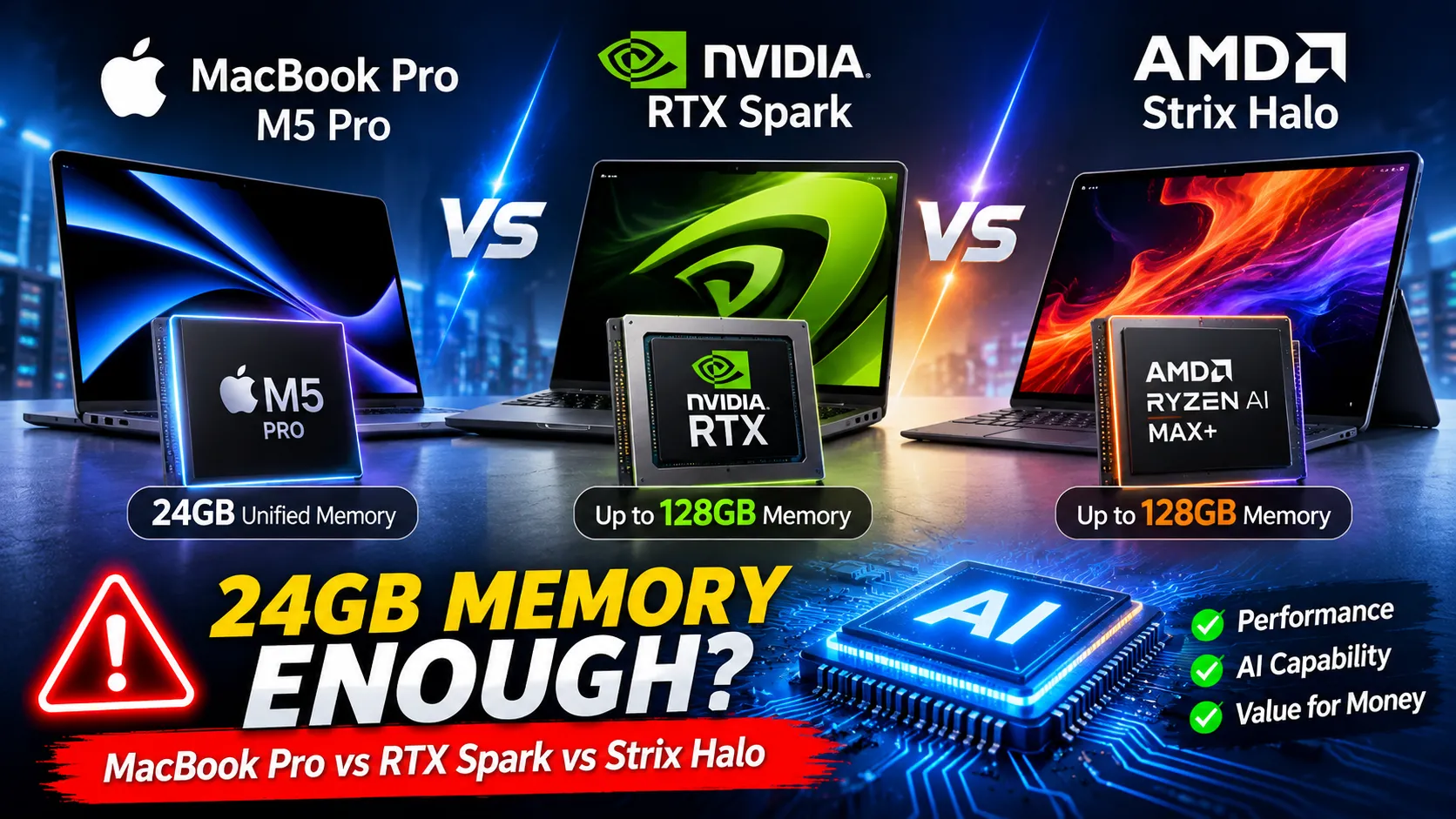 It combines a 16-core Zen 5 CPU with Radeon 8060S integrated graphics. Supported systems can be configured with up to 128GB of LPDDR5X memory.
This is significant because the integrated GPU can use a portion of the system's shared memory.
For example, the ASUS ROG Flow Z13 combines Strix Halo hardware with a portable 2-in-1 design. It offers a touchscreen, a detachable-style keyboard experience and configurations reaching 128GB of memory.
That makes it an unusual alternative to traditional high-end laptops.
The Radeon 8060S is also substantially more capable than the integrated graphics found in ordinary productivity laptops. It makes the device interesting for gaming, content creation and selected GPU-accelerated workloads.
But there is a trade-off: AMD's 256GB/s memory bandwidth is lower than the bandwidth available on higher-end Apple M5 Max configurations. And software support for particular AI frameworks and GPU backends can vary.
Strix Halo is therefore not automatically faster than a MacBook or an NVIDIA system. Its biggest attraction is the combination of high memory capacity, x86 compatibility and a relatively portable Windows device.
4. The Hardware Comparison: Apple vs NVIDIA vs AMD
The following comparison focuses on the configurations and specifications publicly listed by the manufacturers and technology reviewers.
Feature | MacBook Pro 14-inch | NVIDIA RTX Spark N1X | ASUS ROG Flow Z13 |
|---|---|---|---|
Platform | Apple M5 Pro | NVIDIA Blackwell | AMD Strix Halo |
CPU | Up to 18-core M5 Pro | Up to 20-core Grace | 16-core Ryzen AI Max+ 395 |
GPU | Apple integrated GPU | Blackwell RTX GPU | Radeon 8060S |
Memory | 24GB base | Up to 128GB | Up to 128GB |
Memory bandwidth | 307GB/s | Not listed in current N1X laptop spec | 256GB/s |
Operating system | macOS | Windows 11 | Windows 11 |
Form factor | Laptop | Laptop | 2-in-1 laptop/tablet |
Starting price | $2,899 | Not confirmed | Varies by configuration |
Important: The memory-bandwidth figures are not a direct performance ranking. Different architectures, memory controllers, workloads and software stacks can produce very different results.
5. What About NVIDIA DGX Spark?
There is another product worth discussing: NVIDIA DGX Spark.
Unlike RTX Spark N1X laptops, DGX Spark is a compact desktop AI system. It uses the GB10 Grace Blackwell Superchip and includes 128GB of unified LPDDR5X memory.
NVIDIA lists up to 1 PFLOP of FP4 AI performance and support for running large local models. Its specifications include 273GB/s memory bandwidth, 10GbE networking and ConnectX-7 connectivity.
This is not a direct MacBook replacement.
It does not offer the same portable laptop experience, and it runs NVIDIA's DGX operating system rather than macOS or standard Windows.
But for developers who want a dedicated local AI machine, it is a serious option.
The price is also important. NVIDIA increased the DGX Spark Founders Edition MSRP to $4,699 in 2026, so buyers should not assume that more memory automatically means better value.
6. Why Memory Capacity Matters More for Local AI
Traditional laptop reviews often focus on CPU benchmarks, GPU scores, battery life and display quality.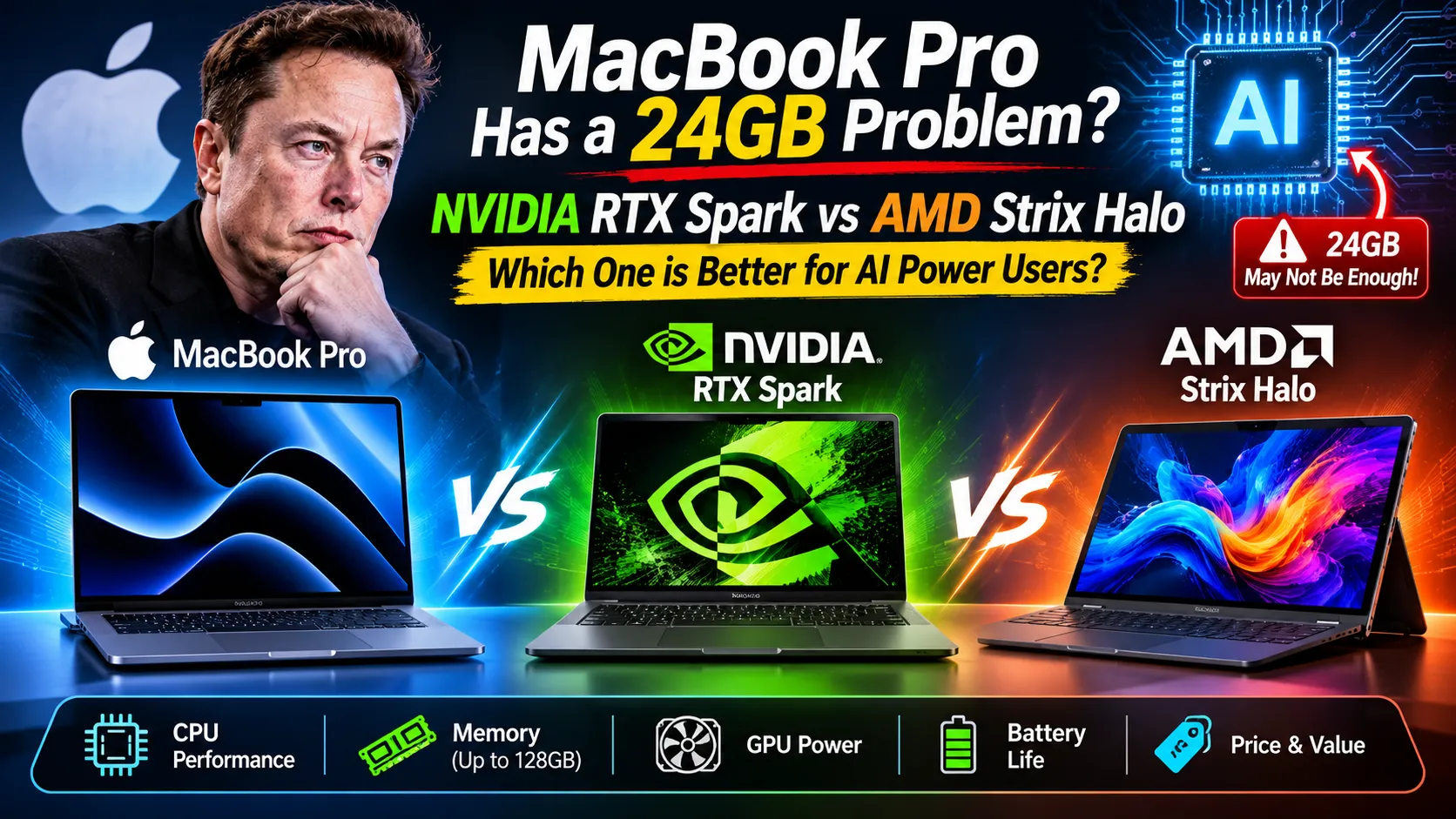 Those measurements remain important, but local AI introduces another major consideration: how much of a model can fit into memory?
A larger memory pool can allow developers to experiment with larger models, longer context windows and multiple applications without immediately running into memory limits.
This does not mean that 128GB automatically makes a computer faster.
Memory capacity determines what can fit. Memory bandwidth influences how quickly data can move. GPU compute determines how much work can be processed. Software optimization determines how effectively the hardware is used.
All four factors matter.
This is why NVIDIA, AMD and Apple should not be compared using memory capacity alone.
For example, NVIDIA's DGX Spark offers 128GB of memory but has 273GB/s bandwidth. AMD's Strix Halo platform offers up to 128GB with 256GB/s bandwidth. Apple's M5 Pro offers 307GB/s bandwidth in its published configuration, while M5 Max can reach 614GB/s.
The best option depends on the model, quantization, inference engine and development framework being used.
7. Which Platform Should You Actually Buy?
Choose the MacBook Pro if:
You rely on macOS applications and workflows.
Battery life, display quality and portability are major priorities.
You edit professional video or work with Apple's media software.
Your local AI workloads fit within your chosen memory configuration.
You prefer Apple's integrated hardware and software experience.
Choose an NVIDIA RTX Spark system if:
Your work depends heavily on CUDA and NVIDIA AI tools.
You develop, test or run local AI models regularly.
You want a machine designed around AI workloads.
Your preferred software stack is optimized for NVIDIA hardware.
Choose an AMD Strix Halo laptop if:
You want a Windows-based laptop with a large shared memory pool.
You need a combination of gaming, development and AI experimentation.
You prefer x86 software compatibility.
You want a portable 2-in-1 form factor with up to 128GB memory.
Choose DGX Spark if:
Local AI development is your primary workload.
You want a dedicated desktop AI system.
You need NVIDIA's CUDA-based development environment.
You do not require a built-in display or laptop portability.
8. Final Verdict: Apple Is Not Finished, But the Competition Is Getting Serious
Apple's MacBook Pro remains one of the strongest premium laptops for professional users. Its display, battery life, performance efficiency and macOS ecosystem are difficult to dismiss.
But the $2,899 entry-level configuration raises a legitimate question for the next generation of power users.
When local AI becomes a major part of everyday computing, 24GB of unified memory may feel restrictive sooner than many buyers expect.
NVIDIA's RTX Spark platform offers a compelling AI-first direction, while AMD's Strix Halo brings high memory capacity to more conventional Windows laptop designs.
Neither platform makes every MacBook Pro obsolete. NVIDIA still needs to prove its laptop experience across real-world workloads, and AMD's AI software ecosystem is not identical to CUDA.
My recommendation: Do not abandon macOS simply because a competing machine advertises more memory. Instead, buy according to your actual workload. If local AI development is your priority, compare 64GB and 128GB configurations before spending nearly $3,000 on an entry-level MacBook Pro.
The future of professional computing will not be decided by the prettiest screen or the fastest processor alone. It will be decided by how much useful work a machine can handle locally—and how much it costs to do it.
SamReview Verdict: The MacBook Pro is still a premium all-rounder, but NVIDIA and AMD are making a stronger case for users who need memory capacity and AI-focused hardware above everything else.
Reviews & Comments (2)
Nice Content
Nice Content
shahinur alam
Expert reviewer and tech enthusiast at SamReview.
Read Next
View All →
Think Your iPhone Is Safe? These 5 Security Changes Could Save You!
Protect your iPhone from thieves, hackers, and scammers with these 5 essential security changes. Discover hidden settings to keep your data and device safe.

Elon Musk Spent Nearly $500 Million on the Midterms and Lost Big — Now His AI Empire Faces a New Threat
Elon Musk invested nearly half a billion dollars in the 2026 US midterm elections, hoping to strengthen Republican political influence. But the results delivered a major setback. Democrats made significant gains, Texas changed political direction, and communities across the country pushed back against large AI data center projects. Now, Musk's growing AI ambitions face a new challenge that money alone may not solve.

Google Bans Android TV Manufacturer After 1.3 Million Devices Are Infected With Malware Backdoor
A massive cybersecurity investigation has uncovered a global botnet hidden inside Android TV boxes and other smart devices. Google has cut ties with the manufacturer Videostrong Technology after discovering that its devices were being used for cybercrime without users' knowledge.